<?xml version="1.0" encoding="utf-8"?><feed xmlns="http://www.w3.org/2005/Atom" xml:lang="en"><generator uri="https://jekyllrb.com/" version="4.4.1">Jekyll</generator><link href="https://wasukira.com/feed.xml" rel="self" type="application/atom+xml" /><link href="https://wasukira.com/" rel="alternate" type="text/html" hreflang="en" /><updated>2026-11-25T22:03:09+03:00</updated><id>https://wasukira.com/feed.xml</id><title type="html">Gibson Wasukira</title><subtitle>Gibson Wasukira is a data engineering and enterprise data architecture practitioner based in Uganda, writing about data platforms, data governance and engineering strategy.</subtitle><author><name>Gibson Wasukira</name><email>wasukira@outlook.com</email></author><entry><title type="html">Part 1 - Principles</title><link href="https://wasukira.com/principles-followed-series-1-part-1.html" rel="alternate" type="text/html" title="Part 1 - Principles" /><published>2022-09-12T08:27:05+03:00</published><updated>2022-09-12T08:27:05+03:00</updated><id>https://wasukira.com/series-1-part-1-building-blocks</id><content type="html" xml:base="https://wasukira.com/principles-followed-series-1-part-1.html"><![CDATA[<p>
    By definition, a data platform is a complete solution for ingesting, processing , analyzing, and presenting the data generated by systems, processes, and infrastructure
</p>

<p>The following principles where defined for what we want in a data platform:</p>
<ul class="list-unstyled">
    <li>• Infrastructure Design</li>
    <li>• Secrets Management</li>
    <li>• Observability</li>
    <li>• Lineage</li>
    <li>• Orchestration and Task Registration</li>
    <li>• Data Certification</li>
    <li>• Query Service</li>
    <li>• Data Subscription</li>
    <li>• Storage Service</li>
    <li>• Data Transformations</li>
    <li>• Data Subscription</li>
    <li>• Data Governance</li>
    <li>• Data Discovery</li>
    <li>• Security</li>
</ul>

<p>Below is a brief overview of these building blocks:</p>

<h2 id="infrastructure">Infrastructure<a class="heading-anchor" href="#infrastructure"><span aria-hidden="true">#</span><span class="visually-hidden">Link to section: Infrastructure</span></a></h2>
<p>
    The services require infrastructure on which to ran, cloud service offerings range from IaaS, PaaS to SaaS, our focus will be IaaS and PaaS
</p>
<p>We will work under the assumption that we work for an AWS shop, our infrastructure will be built on AWS, our data pipelines shouldn’t be tightly coupled with the cloud provider
    service offering, they should be easily portable to a different cloud provider
</p>
<p>
    We should be able to provision and allocate the right number of resources to execute tasks and continuously monitor the resource usage
</p>
<p>
    We should manage our infrastructure using Infrastructure as Code (IaC) and version control as it engenders Idempotency and keeps track of changes to the infrastructure, it also
    helps with prototyping as it enables you to spin up an environment at a moment’s notice, isolating development, and production environments
</p>
<h2 id="observability">Observability<a class="heading-anchor" href="#observability"><span aria-hidden="true">#</span><span class="visually-hidden">Link to section: Observability</span></a></h2>
<p>
    We need to have an operational view of our pipelines and the data platform infrastructure resources, these can be delivered through dashboards, alerting -- for both expected
    events and any anomalies.
</p>
<p>
    We should also be able to track jobs within our pipeline for status and identify reasons for failure should they occur
</p>
<p>
    Pipeline metadata like data freshness, could also be published to these observability dashboards
</p>
<p>We will put in place a centralized logging mechanism for observability</p>
<h2 id="secrets-management">Secrets management<a class="heading-anchor" href="#secrets-management"><span aria-hidden="true">#</span><span class="visually-hidden">Link to section: Secrets management</span></a></h2>
<p>
    We need to securely store our passwords and rotated without causing significant downtime
</p>
<h2 id="orchestration-and-task-registration">Orchestration and Task Registration<a class="heading-anchor" href="#orchestration-and-task-registration"><span aria-hidden="true">#</span><span class="visually-hidden">Link to section: Orchestration and Task Registration</span></a></h2>
<p>
    Analytics workloads (Jobs ) are a bunch of long running tasks and therefore need to be orchestrated by a state machine, we need to identify the order of the execution, then
    have the orchestration service build a data pipeline graph.
</p>
<p>
    The orchestration service will initiate and track the execution of task; the orchestration service will serve as our task registry
</p>
<h2 id="data-lineage">Data Lineage<a class="heading-anchor" href="#data-lineage"><span aria-hidden="true">#</span><span class="visually-hidden">Link to section: Data Lineage</span></a></h2>
<p>
    During transformations, tasks will have to provide some sort of indication of their inputs and outputs, this metadata will be used by the orchestration service to draw up the
    DAG graph.
</p>
<p>
    The lineage graph represents relationships between a collection of tasks, this helps with traceability of dependencies
</p>
<h2 id="data-certification">Data Certification<a class="heading-anchor" href="#data-certification"><span aria-hidden="true">#</span><span class="visually-hidden">Link to section: Data Certification</span></a></h2>
<p>
    We shall have to embed data quality checks in between tasks to ensure only good quality data gets to dashboards and the subscription service
</p>
<h2 id="data-discovery">Data Discovery<a class="heading-anchor" href="#data-discovery"><span aria-hidden="true">#</span><span class="visually-hidden">Link to section: Data Discovery</span></a></h2>
<p>
    To create data democratization and eliminate tribal knowledge within our organization, we will need a single searchable portal from where data users will get answers to
    questions like:
</p>
<ul class="list-unstyled">
    <li>• Where can I find data about a verb X, noun Y ?</li>
    <li>• Who owns certain data sets and how the data is created, Is it trustable?</li>
    <li>• Column level statistics, e.g., Mean, Standard deviation</li>
    <li>• The frequently the data is refreshed</li>
    <li>• Orchestration and Task Registration</li>
    <li>• What is the context of the data</li>
</ul>
<h2 id="data-subscription-service">Data Subscription Service<a class="heading-anchor" href="#data-subscription-service"><span aria-hidden="true">#</span><span class="visually-hidden">Link to section: Data Subscription Service</span></a></h2>
<p>
    We shall have to make it possible to integrate with external services, these could be dashboards, reporting engines, and Rest APIs. These consumers should be able to subscribe
    to this data subscription service
</p>

<h2 id="query-service">Query Service<a class="heading-anchor" href="#query-service"><span aria-hidden="true">#</span><span class="visually-hidden">Link to section: Query Service</span></a></h2>
<p>
    Upon ingestion of data into the storage layer, it will be accessible through a query service, transformation tasks will use this service to fetch and persist data into the
    storage layers
</p>
<p>
    This is a layer over an SQL query engine or data warehouse, it should be able to scale depending on the complexity and concurrency of the queries
</p>
<h2 id="data-governance">Data Governance<a class="heading-anchor" href="#data-governance"><span aria-hidden="true">#</span><span class="visually-hidden">Link to section: Data Governance</span></a></h2>
<p>
    We should be able to define authentication and fine-grained access controls on the data resident in our data stores. This can be implemented within the query service; these
    access controls should enforce authorization mechanism to limit on what users can have access to
</p>
<h2 id="data-transformation">Data Transformation<a class="heading-anchor" href="#data-transformation"><span aria-hidden="true">#</span><span class="visually-hidden">Link to section: Data Transformation</span></a></h2>
<p>
    When creating transformation tasks, we should be able to generate metadata which includes upstream dependencies, these dependencies are used by our orchestration tool to
    dynamically generate our transformation DAGs and lineage
</p>
<p>Transformations can either be Stream processing or batch processing depending on the need, our architecture covers both, this kind of architecture is called a Lambda
    Architecture</p>
<h2 id="security">Security<a class="heading-anchor" href="#security"><span aria-hidden="true">#</span><span class="visually-hidden">Link to section: Security</span></a></h2>
<p>
    Security considerations will be taken on data in transit and at rest
</p>]]></content><author><name>Gibson Wasukira</name><email>wasukira@outlook.com</email></author><category term="Data Architecture" /><category term="Data Platform" /><summary type="html"><![CDATA[In this part of the series, we explore the principles for what we want in the data platform architecture]]></summary></entry><entry><title type="html">Part 2 - Architecture Requirements Gathering</title><link href="https://wasukira.com/architecture-requirements-gathering-part-2.html" rel="alternate" type="text/html" title="Part 2 - Architecture Requirements Gathering" /><published>2022-09-12T08:27:05+03:00</published><updated>2022-09-12T08:27:05+03:00</updated><id>https://wasukira.com/series-1-part-2-architecture-requirements-gathering</id><content type="html" xml:base="https://wasukira.com/architecture-requirements-gathering-part-2.html"><![CDATA[<p>
    In this second part of the series, we shall gather information that will drive the architectural design of the data platform. This is the genesis of our data platform. At the
    end of this phase, we should have a slight inclination of what kind of data pipeline we will build
</p>
<p>
    Our primary role as data engineers is to build data pipelines that deliver data to end users
</p>

<p>Before we start building our pipeline, we need to get answers to the following questions:</p>
<ul class="list-unstyled">
    <li>• Who are the data platform stakeholders? -- These could include Business Analysts, Dashboard Consumers, REST API subscriptions</li>
    <li>• What data needs to get consumed?</li>
    <li>• Which data helps business make decisions?</li>
    <li>• What systems are used to capture this data?</li>
    <li>• What data governance policies should be in place? o Who will have access to this data? – Security and Compliance</li>
    <li>• More importantly what is the budget?</li>
    <li>• Government compliance requirements, what are limitations on the geographical location of our data</li>
</ul>

<h2 id="determine-the-stakeholders">Determine the Stakeholders<a class="heading-anchor" href="#determine-the-stakeholders"><span aria-hidden="true">#</span><span class="visually-hidden">Link to section: Determine the Stakeholders</span></a></h2>
<p>Let’s say our stakeholders are:</p>
<ul class="list-unstyled">
    <li>• Marketing; Marketing Director, Usage and Retention Analyst</li>
    <li>• Sales; Sales Director, Sales Agents, Sales Analyst</li>
    <li>• Finance; CFO, Investment Analysts</li>
    <li>• Business Analysts</li>
    <li>• Customers with Back-end developers as a proxy</li>
    <li>• IT; CTO, Security and Compliance</li>
    <li>• CRM – surprised ??? will discuss the reverse-ETL</li>
</ul>

<h2 id="what-data-needs-to-get-consumed">What data needs to get consumed?<a class="heading-anchor" href="#what-data-needs-to-get-consumed"><span aria-hidden="true">#</span><span class="visually-hidden">Link to section: What data needs to get consumed?</span></a></h2>
<ul class="list-unstyled">
    <li>• CFO wants his financial statements visualized</li>
    <li>• Sales agents want to know what issues are being reported by customers</li>
    <li>• The Sales Director:
        <ul class="list-unstyled">
            <li>• Needs to know how many prospects are in the leads pipeline, how many were converted into accounts over a certain period</li>
            <li>• Wants to track his Sales Agents performance</li>
            <li>• Wants daily visibility on how different products are performing</li>
        </ul>
    </li>
    <li>• Sales Analyst whose role is to build promotional products, has a rewards/loyalty program that requires real time data feeds to identify who qualifies for a reward
        and who doesn’t </li>
    <li>• Marketing Director is so big on retention, he wants real time updates on usage/access patterns, for instance how long a customer spends looking at a certain page, and
        which page was clicked after, did that session convert into a sale?</li>
    <li>• Business Analysts (BAs) need access to sales raw data, customer complaints and query resolution time</li>
    <li>• Customer needs to view some sort of statement on demand through the mobile app</li>
    <li>• CTO and Scrum master need to know bugs being reported, how long it took to fix them</li>
    <li>• CTO also needss know the application traffic access patterns</li>
    <li>• Data Scientist ?? His/Her List is exhaustive</li>
</ul>
<h2 id="what-governance-policies-should-be-in-place">What governance policies should be in place?<a class="heading-anchor" href="#what-governance-policies-should-be-in-place"><span aria-hidden="true">#</span><span class="visually-hidden">Link to section: What governance policies should be in place?</span></a></h2>
<ul class="list-unstyled">
    <li>• Business Analysts (BAs) should only view sales and customer complaints datasets</li>
    <li>• CFO, CTO, Marketing Director, Investment Analyst should be able to view all datasets</li>
    <li>• Sales Agents should only view sales data</li>
</ul>
<p>Remember to always follow the Principle of Least Privilege</p>
<h2 id="compliance">Compliance<a class="heading-anchor" href="#compliance"><span aria-hidden="true">#</span><span class="visually-hidden">Link to section: Compliance</span></a></h2>
<ul class="list-unstyled">
    <li>• Government Restrictions on the geographic location of the data, there are no restrictions for out hypothetical case</li>
</ul>
<h2 id="what-is-the-budget">What is the budget?<a class="heading-anchor" href="#what-is-the-budget"><span aria-hidden="true">#</span><span class="visually-hidden">Link to section: What is the budget?</span></a></h2>
<ul class="list-unstyled">
    <li>• CTO tells you, that the monthly budget for the data platform is $500, yea we are going to build a cloud native data platform that roughly costs this much</li>
</ul>
<h2 id="data-sources-what-systems-are-used-to-capture-the-data">Data Sources – What systems are used to capture the data<a class="heading-anchor" href="#data-sources-what-systems-are-used-to-capture-the-data"><span aria-hidden="true">#</span><span class="visually-hidden">Link to section: Data Sources – What systems are used to capture the data</span></a></h2>
<p>With the above information, we then move onto identifying the the systems from which to extract this data from</p>
<p>In Data Engineering terminology, Operations/transaction data is referred to as System of Record (SOR) data.</p>
<p>So, the SOR data sources will be:</p>
<ul class="list-unstyled">
    <li>• CRM to serve the customer complaints and prospects queries, we note that this runs on a MySQL database</li>
    <li>• Accounting System that will serve the CFO & Investment Analyst queries, we also note that it exposes the required source data over a REST API</li>
    <li>• Business Support System(BSS) – this is a system (could be built inhouse) custom to our business domain, for a bank, it’s a banking system,
        for a micro-lending institution, it’s a loan management system (LMS), for a supermarket it’s a Point of Sale (POS). The BSS will serve the Sales, BA queries and runs on
        a PostgreSQL DB</li>
    <li>• If the BSS is behind an ALB(WAF) or API gateway, we will turn on ALB/WAF logging and have them persisted to AWS S3, these logs should address the traffic queries</li>
    <li>• The session data will be persisted into a NoSQL storage store</li>
</ul>

<p>So, we have relational and nonrelational models, our ERP, CRM, and BSS are backed by relational data stores, and these are Postgres DB and MySQL DB</p>

<p>The nonrelational “NoSQL” data stores have 2 categories, Document databases and Graph databases, with document DBs data is represented as self-contained; relationships
    between one document and another are rare in this case</p>
<p>Graph databases will be used later in this series, but they are used in applications where almost everything is related to anything</p>

<p>Therefore data sources are.</p>
<ul class="list-unstyled">
    <li>• CRM – MySQL DB</li>
    <li>• Accounting System – Rest API</li>
    <li>• BSS – PostgreSQL DB</li>
    <li>• ALB/WAF logs – S3 Bucket</li>
    <li>• Session data – Elasticsearch</li>
</ul>

<p>
   With the above information we are ready to start building our architecture
</p>]]></content><author><name>Gibson Wasukira</name><email>wasukira@outlook.com</email></author><category term="Data Architecture" /><category term="Data Platform" /><summary type="html"><![CDATA[In this second part of the series, we shall gather information that will help drive the architectural design of the data platform. At the end of this phase, we should have a slight inclination of what kind of data pipeline we will build]]></summary></entry><entry><title type="html">Building a Scalable Cost Optimized Resilient Data Platform</title><link href="https://wasukira.com/cost-optimized-data-platform-part-1.html" rel="alternate" type="text/html" title="Building a Scalable Cost Optimized Resilient Data Platform" /><published>2022-09-06T20:27:05+03:00</published><updated>2022-09-06T20:27:05+03:00</updated><id>https://wasukira.com/cost-optimized-data-platform-series-1-introduction</id><content type="html" xml:base="https://wasukira.com/cost-optimized-data-platform-part-1.html"><![CDATA[<p>
    For any business running cloud native infrastructure, the infrastructure costs will increase as the business grows, and cost efficiency is always paramount.
</p>
<p>
    Data engineering requires a high level of autonomy, so as a data engineer you must have a firm grasp of the infrastructure on which your data pipelines run.</p>
<p>
    You should be able to design, build and operationalize a data platform, then secure and monitor the data processing systems running on it; and for this reason a "You Build
    it, You Run it!" approach for data engineers especially in startups is always encouraged.
</p>
<p>
    You should be able to troubleshoot issues within a pipeline without any reliance on a third party; the DevOps/Platform engineer might be too busy to be bothered about the
    intrinsic details of the "Spark Shuffle" process when setting up or making infrastructure decisions and this will have a direct influence on your pipeline performance, it
    could be either transient or manifest later
</p>
<p>
    If you ran this infrastructure, as a data engineer, one of your KPIs, in a finance perspective will be to keep these costs at a minimum while still meeting SLAs set by
    business
</p>
<h2 id="so-how-can-we-build-a-cost-optimized-but-resilient-data-platform">So how can we build a cost optimized but resilient data platform?<a class="heading-anchor" href="#so-how-can-we-build-a-cost-optimized-but-resilient-data-platform"><span aria-hidden="true">#</span><span class="visually-hidden">Link to section: So how can we build a cost optimized but resilient data platform?</span></a></h2>
<p>
    In this series of posts, I discuss the data architecture of a scalable cost optimized resilient data platform, the tooling (toys), the reasons for the choices for tooling, the
    alternatives to the chosen tooling and the different persona in the ecosystem
</p>

<p>
    <p>The entire platform infrastructure is managed by Infrastructure as Code (IaC), the choice for this being Terraform, and complete project will be shared at a GitHub repo
</p>
<p>
    A cloud-agnostic platform was paramount to this project to alleviate cloud lock-in concerns but were necessary cloud-native services where used.
</p>

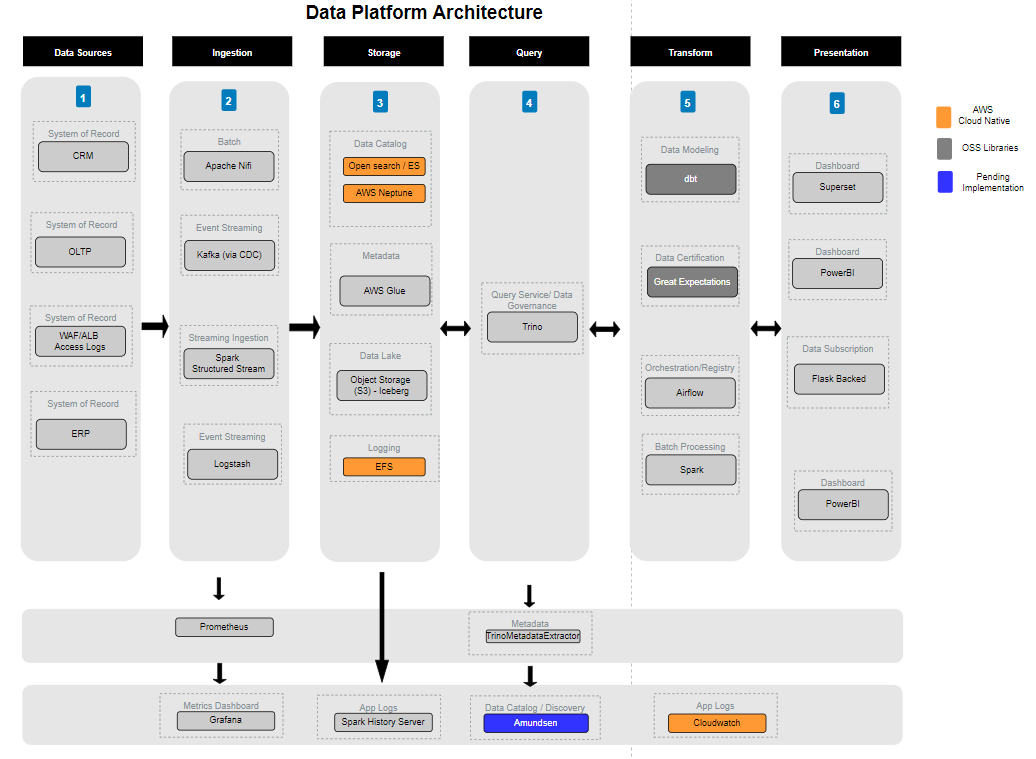
<p>The overall architecture of the project can be found below, or as a
    <a href="/assets/img/platform-architecture.png" download="platform-architecture">download link</a></p>

<figure class="diagram">
    <a href="/assets/img/platform-architecture.png">
        <img src="/assets/img/platform-architecture.png" width="1036" height="759" loading="lazy" decoding="async"
             alt="Data platform architecture in six layers: data sources (CRM, OLTP, WAF/ALB access logs, ERP); ingestion (Apache NiFi, Kafka via CDC, Spark Structured Streaming, Logstash); storage (OpenSearch and AWS Neptune data catalog, AWS Glue metadata, S3 data lake with Iceberg, EFS logging); query and governance (Trino); transform (dbt, Great Expectations, Airflow, Spark); and presentation (Superset, Power BI, a Flask-backed data subscription service). Prometheus and Grafana, Spark History Server, Amundsen and CloudWatch provide monitoring, logs and data discovery.">
    </a>
    <figcaption>Data platform architecture. Select the diagram to open it at full size.</figcaption>
</figure>]]></content><author><name>Gibson Wasukira</name><email>wasukira@outlook.com</email></author><category term="Data Architecture" /><category term="Data Platform" /><summary type="html"><![CDATA[In this series of posts, I discuss the data architecture of a scalable cost optimized resilient data platform, the tooling (toys), the reasons for the choices for tooling, the alternatives to the chosen tooling and the different persona in the ecosystem]]></summary></entry></feed>